Why Choose a Radiant Above-Ground Pool?

Radiant’s Metric Series isn’t your typical above-ground pool — it’s engineered with the same technology once developed for NASA. With lightweight, 2-inch-thick insulated panels that are stronger than concrete and more efficient than steel, you get unmatched strength, durability, and energy savings. These pools install quickly, last for decades, and come backed by a true lifetime transferable warranty — even covering winter damage. Plus, every pool is proudly American-made and 100% recyclable, so it’s as smart for your backyard as it is for the planet.

Compare Pool Types

Feature Vinyl Pools Fiberglass Pools Above Ground Pools
Cost Starting at $50,000 Starting at $50,000 Starting at $10,000
Best For Homeowners looking for affordable customization Homeowners seeking quick installation & low maintenance Budget-conscious families or temporary installations
Customization Moderate – Standard sizes & shapes with liner choices Low – Limited to pre-molded shapes from manufacturer Low – Limited shapes and sizes
Design Features Steps, benches, shallow ends optional Built-in steps, benches, tanning ledges (varies by model) Basic setups; limited to ladder entry, optional decks
Durability Liner lasts 8–10 years; may puncture or fade Highly durable shell; resistant to algae and cracks Steel or resin frames may rust or wear over time
Maintenance Moderate – Liner care and water balance needed Low - Surface resists algae, water balance needed Moderate - Liner care and water balance needed
Lifespan Up to your lifetime with liner replacements periodically Up to lifetime with proper care and maintenance 10-20+ years depending on type and upkeep
Repair/Replacement Costs Liner replacement is affordable and common Shell repairs are rare Repairs are generally inexpensive but more frequent
Insulation & Energy Efficiency Minimal to maximum R-10 Insulated Moderate – Some shells offer thermal insulation Minimal to maximum R-10 insulated
Installation Time Moderately fast - 3-5 weeks Fast - 2-4 Weeks Very Fast – often installed in 1–3 days
Explore Vinyl Explore Fiberglass Explore Above Ground

Pool Services

Service Area

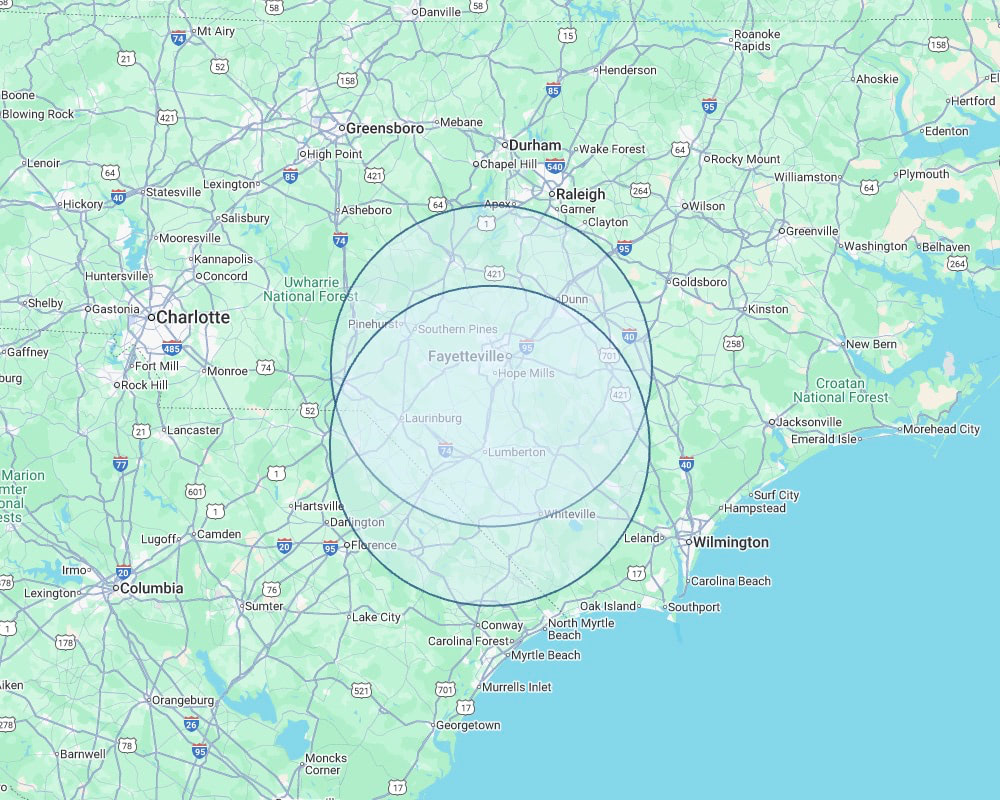
We proudly serve the surrounding region within roughly 50 miles of our showrooms in Lumberton and Fayetteville North Carolina. Whether you’re nearby or a short drive away, our team is happy to help. Not sure if you’re in our service area? Just ask—we’ll let you know!
Frequently Asked Questions

  • Structural fill is required when backfilling. Do not use expansive soil (e.g., clay). Structural fill most commonly refers to earthen materials that are compacted to create a strong and stable base which would support a structure. The makeup of structural fill varies regionally across the United States and Canada.
  • Backfill may go directly against a Radiant pool wall.
  • Backfill as the pool is filling with water, manually compacting every 8”-12” (Do not use compacting
    machinery.) Hand backfill around skimmers, lights and inlets. Be sure that piping is buried, but not crushed.
  • Although not recommended, if backfilling completely before pool is filled, the inside of the pool straight walls must be crossed braced at the top.
  • Proper drainage is incredibly important on all swimming pool installations.
  • Groundwater Management - Semi-inground and fully inground pools can be damaged by an inrush of groundwater. In cases of extreme rain or a very high natural water table, groundwater can push against the pool walls enough to damage the walls. The walls are especially susceptible to damage if the pool is left empty (never leave a pool without water). The uphill run-off and accumulated groundwater should be redirected around the pool incorporating a French drain concept using a perforated drain pipe and water relief area away from the pool and other structures.
  • Exterior Corrosion Prevention - If standing water or wet soil is in contact with the exterior of the pool wall, corrosion may occur. Aluminum does not "rust" since there is no iron in the material. Although aluminum is extremely corrosion resistant, all metals can corrode over time when exposed to water (except for noble metals such as gold and platinum!).
  • Metric Series Pools are designed to be installed aboveground, semi-inground, or fully inground. More concrete is required for semi-inground or fully inground Metric installations than a standard aboveground installation.
  • Radiant Pools requires a minimum of 8” concrete collar around the entire pool if any point of the pool wall is 26” or greater in the ground.
  • A concrete collar is defined as a ring of concrete on the exterior of the pool wall, at the base of the pool wall. The collar is 16" wide and 8" deep, usually equating to between 3 and 6 yards of concrete.
  • Since all thermoplastic steps are required to be fully backfilled to the top of the pool wall, all Metric pools with thermoplastic steps require a concrete collar.
  • The concrete collar works in conjunction with a properly designed and installed drainage system to ensure the integrity of the swimming pool walls.
  • All swimming pools, including Radiant Pools, must be installed in accordance with National Electric Code (NEC) to ensure safety and to help prevent corrosion.
  • Electricians should be familiar with the requirements of the NEC, as well as any local permitting requirements for swimming pool grounding.
  • An excellent resource on grounding exists at Trouble Free Pool, a registered 501(c)3 non-profit who displays no advertising on their site nor is their advice compromised by financial incentives. https://www.troublefreepool.com/wiki/index.php?title=Electrical_Bonding
  • Always defer to local codes and requirements, but 8 AWG bare copper wire is commonly connected to the anchor plates at multiple locations around the bottom of Radiant Pools as part of the bonding system. Since these plates are bolted to the pool panels, they create a continuous path for bonding. Additional steps are required to bond to the pool water, any metal objects within 5 feet of the pool, and to pump/heater and other pool equipment.

Properly installed and maintained salt systems are safe to use with Radiant Pools.

Keeping your pool's water chemistry correct is very important for sanitation but is equally important to prevent pool wall corrosion. Radiant Pool’s aluminum walls are extremely corrosion resistant, but all metals will exhibit corrosion over time if the pool’s chemistry is not maintained correctly.

We have found that salt systems require much more maintenance than traditional liquid/granule chlorine systems to keep pool chemistry at the correct levels. Improperly installed and maintained salt systems will accelerate the corrosion process on pool walls.

If you are going to use a salt system, we recommend testing the ground for stray electricity, use a sacrificial anode, and test the water quality frequently.

Your Radiant Metric Series pool is to be winterized in the same manner as other pools. With a Metric Series pool there are some specific steps you should follow:

  1. Make sure all ladders, pool cleaners, toys, floats are out of the water and stored.
  2. Make sure the water is clean, balanced, free of algae, and winter chemicals are added.
  3. Water is generally lowered to just below the skimmer to ease the plugging and draining of the hoses, pipes and skimmer.
  4. Return Inlet: Remove directional (eyeball) and insert rubber or plastic winterizing plug from the inside of the pool. We recommend a #10 rubber plug or a Hayward SP1022C plug.
  5. Make sure the filter and pump pipes, hoses are drained of water. Please follow pump and filter manufacturers’ specific instructions for winterizing.
  6. Skimmer: Remove basket and weir. Insert gizzmo or styrofoam and/or winterizing plate to prevent ice from forming a solid block that could damage your skimmer. If using a gizzmo, the standard size is recommended for aboveground skimmers. For inground skimmers, the super Gizzmo will work best.
  7. Install aboveground winter cover by inserting beading on cover into bead track of your Metric coping. The cover bead track on the standard 2” coping is located on the exterior of the pool. The cover bead on the 4” coping is located on the interior of the pool, above the liner track. Excess cover material should be inside the pool and resting on the water. Add a little water on the cover in windy areas to hold the cover down. No air pillow or flotation is required in the middle of the pool.
  8. Check the level of the water under the cover after about one week, a good test for a slow leak in your liner. "Ice Drop" occurs when water is lost during the winter, causing the water level to fall below the ice cap, which causes the ice cap to drop into the pool as it thaws, thereby damaging the pool walls and/or compression seams.

For some of the specific “how to’s” it may be necessary to contact your local pool professional.